
Before the green cup, there was a bag of beans
You recognize the name before you read the label. Then the shelf presents a more difficult choice: ground coffee or whole beans, a medium roast or a dark one, a bag or a box of capsules. Familiarity gets your attention, but it does not tell you which package belongs beside your coffee maker.
That is an interesting place to begin the Starbucks story. According to the brand’s original-store history, its first Seattle shop opened at Pike Place Market in 1971, selling whole-bean coffee, tea and spices. The business began with something a customer would take away and prepare.
The detail matters because the coffeehouse can overshadow the coffee itself. A counter, a menu and a familiar drink may be your first association with Starbucks. Its beginnings invite another picture: someone choosing beans, carrying a package home and deciding how to brew them.
You do not need to recreate a particular store to enjoy that connection. Your kitchen has its own rhythm. Perhaps you make a pot before work, grind enough beans for two cups or press a button between meetings. Choosing coffee starts with that ordinary scene, rather than with the size of a company.
Howard Schultz saw another possibility in Milan
The official company timeline records Howard Schultz joining Starbucks in 1982. During a visit to Milan the following year, he saw the popularity of espresso bars. In 1985 he founded Il Giornale; in 1987 that business acquired Starbucks’ assets and adopted its name.
Those milestones describe a change in how the coffee reached people: from selling beans toward serving drinks in a coffeehouse. They do not require an invented conversation or a claim about what every customer felt. The change itself is enough to make the story human: someone encountered a different daily custom and worked to build a business around it.
For a home brewer, the useful connection runs in both directions. A café can introduce you to a flavor or a preparation you want to explore. A bag lets you explore at your own pace. They are related experiences, but the equipment, recipe, water and ingredients may differ.
Buying Starbucks coffee therefore does not promise an identical version of a drink ordered in a store. It gives you a particular coffee to prepare with your own equipment. That distinction makes the story more useful when you reach the product listing.
Pike Place Roast: a medium-roast starting point
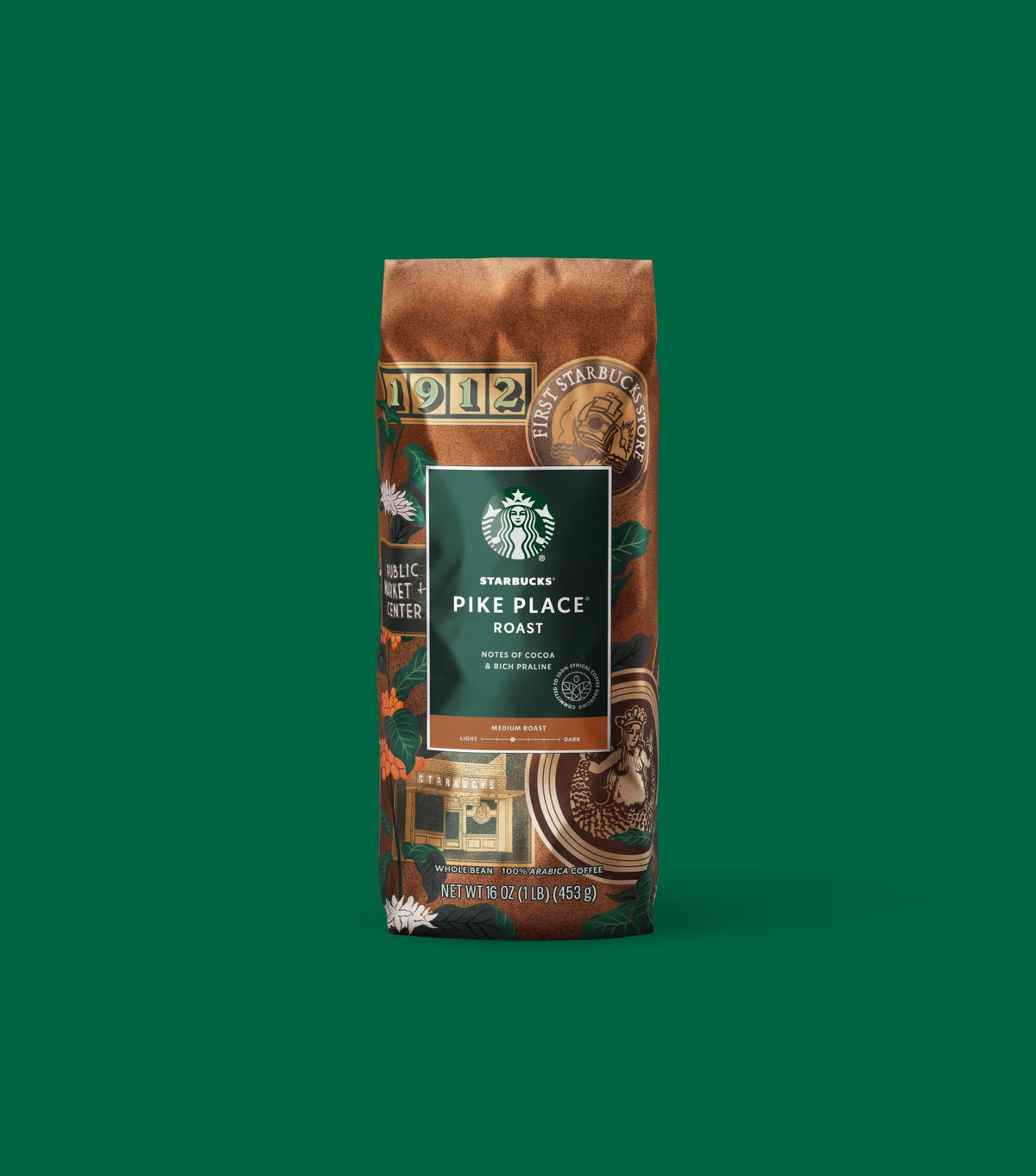
If the name of the original market has made you curious, Pike Place Roast is a natural product to investigate. The official Starbucks Shop description identifies it as medium roast, with cocoa and rich praline flavor notes. These are the manufacturer’s tasting references, not results from a Snapmart tasting.
In Snapmart’s catalog, the linked presentation is Pike Place Roast ground coffee, 28 oz. That detail should guide the purchase more than the photograph alone. A roast name can appear on several sizes and formats, and a marketplace may let you change the selected variation.
A medium roast can be a sensible category to explore if you are comparing the brand’s roast levels and have not settled on a dark roast. It is not a promise of a particular bitterness, caffeine content or result in every brewing method. Read the exact product description alongside the way you usually drink coffee.
View Pike Place Roast at Snapmart View the 28 oz ground listing on Amazon ↗
The format should fit the machine you already own
Ground coffee removes the grinding step. Whole beans give you a grinding step to control, provided you have a suitable grinder. Capsules remove several preparation choices, but require the correct capsule system. These are different routines, even when the brand name on the package stays the same.
For drip brewing, check whether the grind and filter match your machine’s instructions. For an espresso machine with a portafilter, do not assume that a general ground-coffee listing has the grind your setup needs. The word espresso on a roast name also does not turn beans into capsules or establish machine compatibility.
Capsule names deserve particular attention. A K-Cup listing and a Nespresso Original listing describe different systems. Do not treat them as interchangeable or assume Original capsules fit Vertuo. Read your machine’s manual and the current listing before selecting the box.
If the equipment is still undecided, our coffee machine catalog and guide to making espresso at home offer a separate place to compare preparation choices. Choose the machine and coffee together, with the format clearly identified.
Which Starbucks coffee should you compare?
Start with a short list based on what you need to change. Someone exploring a different roast has a different question from someone trying to find capsules for an existing brewer. The following links retain the exact Amazon destinations in the Snapmart catalog; they do not imply that every variation is the same product.
- Pike Place Roast, ground, 28 oz: the medium-roast focus of this article. View on Amazon.
- Sumatra, ground, 18 oz: compare this dark-roast listing if roast level is your main question. View on Amazon.
- Blonde Espresso Roast, whole bean, 28 oz: a lighter-roast option that requires grinding. View on Amazon.
- Ground coffee variety pack, three 12 oz bags: inspect the included coffees before choosing a mixed pack. View on Amazon.
- French Roast, 96 K-Cup pods: a dark-roast capsule listing; check the brewer system and quantity. View on Amazon.
- Blonde Espresso Roast, 22 K-Cup pods: a capsule presentation, distinct from the whole-bean bag above. View on Amazon.
- Nespresso Original variety pack, 50 count: check the assortment and Original-system compatibility. View on Amazon.
- Nespresso Original dark-roast espresso, 50 count: another Original capsule listing, rather than loose ground coffee. View on Amazon.
Quantity is a practical choice too. Compare the amount with your actual consumption and storage space. A larger package is not automatically the right purchase, and we do not assign a savings claim without checking current prices and comparable quantities.
Make the first cup easy to understand
Use a method you already know when you try a new coffee. Follow the brewer’s instructions, measure coffee and water where your method allows it, and taste the drink as you normally serve it. This gives you a useful starting point without pretending there is one recipe for every kitchen.
Change one variable at a time for the next preparation. If you adjust both the amount of coffee and the water, it becomes harder to know which change influenced the cup. You do not need to identify every advertised note to decide whether you would like another cup.
Keep the package information handy, including the roast and format. Those details help you repeat a purchase or compare it with another coffee. A simple note about what you prepared is more useful than relying on the color of a bag you may not see again.
What should you check before buying Starbucks coffee?
Is Pike Place Roast a capsule? The featured listing here is ground coffee in a 28 oz bag. Other presentations may exist, so verify the chosen variation.
Are the two Blonde Espresso listings duplicates? The catalog distinguishes whole beans from K-Cups. Similar names do not make the preparation formats interchangeable.
Where does checkout happen? Snapmart helps you compare and discover. Amazon handles the purchase and payment; check its current price, seller, availability, shipping and returns.
Have we tested these coffees ourselves? This article combines documented brand history with catalog-based buying guidance. It does not report a personal tasting or award a rating.
The story continues when you open the bag
The Seattle origin gives the name a place. Your routine gives the purchase a purpose. If Pike Place Roast sounds like a useful next coffee to explore, start by checking that the ground format and 28 oz quantity suit your brewer and consumption.
Explore Pike Place Roast at Snapmart
Would you like to try it? Review Pike Place Roast ground coffee on Amazon, confirm the presentation, then decide. The next part is a small gesture: opening a bag, measuring your coffee and making room for a cup in your own morning.
A note on the featured bag. The 28 oz ground presentation brings the story back to buying coffee for home preparation. Its practical advantage is a step you do not have to perform: grinding. That can suit someone whose brewer accepts the supplied grind and who wants a straightforward routine. It does not establish freshness on arrival or suitability for every espresso machine. Check the variation, package information and brewing guidance on the current listing. The historical connection explains the name; those present-day details help you decide whether this particular bag belongs in your kitchen.
Sources and related stories
- Starbucks: original-store history and historical photograph.
- Starbucks: company timeline, published in 2023.
- Starbucks Shop: Pike Place Roast description and product image.
Continue with Peet’s and Espresso Forte, the story of Lavazza or all our coffee guides.
Purchases are completed on Amazon. Product presentations can change; verify the current listing. Manufacturer flavor descriptions are attributed references, not a guarantee of your experience.