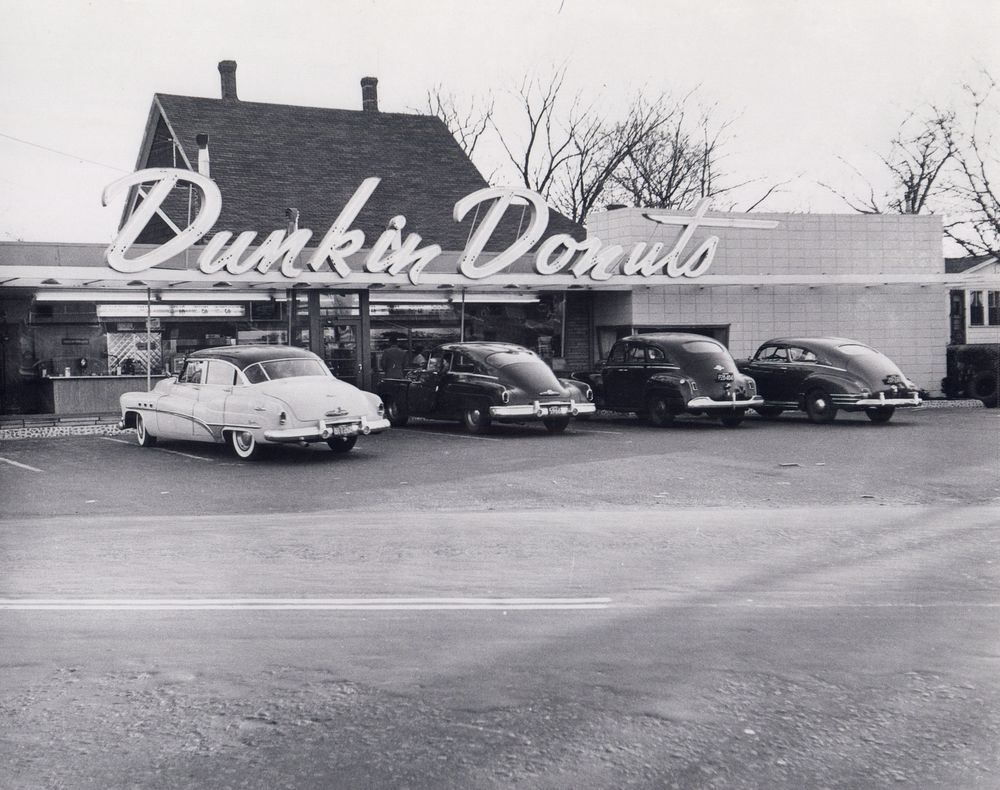
Someone had to bring coffee to the workers
A coffee break can look unremarkable from the outside. A cup, a few minutes and something to eat before the day continues. But when you are working to someone else’s schedule, having that break within reach matters. That ordinary need is a useful way into the story of Dunkin’.
In its 2002 account of William Rosenberg’s life, Dunkin’ describes how he served coffee, pastries and sandwiches to factory workers after World War II. He financed the business with $1,500 in war bonds and $1,000 borrowed from relatives, eventually using converted trucks to reach customers.
The starting point was a person arranging practical things: food that could travel, vehicles that could carry it and customers who needed it during a working day. You do not have to imagine a grand plan to understand why that work mattered. The service had a place in someone’s routine.
The University of New Hampshire’s Rosenberg International Franchise Center connects that catering business with Open Kettle, the coffee-and-donut restaurant Rosenberg opened with Harry Winokur in Quincy, Massachusetts, in 1948. A business that moved between customers had acquired a fixed address.
There is a recognizable shift in that detail. Instead of waiting for a vehicle to arrive, a customer could return to the same counter. For someone choosing coffee today, the equivalent question is equally concrete: where does this coffee fit into the day I actually have?
A name taken from a small gesture
The official Then and Now history dates the change from Open Kettle to Dunkin’ Donuts to 1950. It explains the name through the habit of dunking a donut in coffee. The product pairing was there in the words people would say.
The appeal of that connection is its scale. It does not ask you to picture an executive office or an expansion map. It asks you to picture a hand, a donut and a cup. A name can carry a familiar action further than a technical description ever could.
Names also accumulate memories. You might remember a stop on a commute, a family breakfast or a cup carried out of a shop. Someone else may know Dunkin’ mainly from a package in a supermarket. Those different associations can all lead to curiosity about the coffee, but the package still needs to fit your brewer.
That is where a brand story earns its place in a buying guide. It gives context to the name without asking history to answer questions about grind, quantity or compatibility. Those answers come from the particular product you choose.
The baker who made a routine memorable
A 2025 retrospective from Inspire Brands recalls the Fred the Baker campaign, played by Michael Vale, running from 1982 to 1997. Its familiar line was “Time to make the donuts.” A fictional working routine became part of the brand’s advertising identity.
The character belonged to advertising, rather than to a documentary account of the founder’s life. Keeping that distinction makes the story clearer. Rosenberg built a business; Vale portrayed a baker. Each belongs to a different part of how people came to recognize the name.
In its 2018 announcement, the company said its shorter Dunkin’ branding would take effect in January 2019, reflecting a stronger focus on beverages and convenience. The name shortened, while the coffee remained central to the identity it described.
For a reader making coffee at home, that long association with daily routine is the useful thread. Your morning does not need an advertisement around it. It needs a coffee you can prepare in the time and with the equipment you have.
Original Blend is a medium-roast coffee
The official Dunkin’ at Home page identifies Original Blend ground coffee as medium roast and describes its flavor as smooth. That is the manufacturer’s description. This guide does not report a personal tasting or turn a brand claim into an independent score.
At Snapmart, the two catalog entries discussed here are Original Blend ground coffee in a 30 oz canister and Original Blend in a 60-count K-Cup listing. The name and roast level connect them, but the preparation format separates them. Start with that difference before comparing the amount.

View Original Blend ground coffee at Snapmart
A medium-roast label helps identify the product category, but it does not establish a precise caffeine amount or guarantee the same cup from different machines. Use it alongside the format and the manufacturer’s current package information.
Choose the 30 oz canister when ground coffee fits your method
The ground format removes a step: you do not need to grind beans before brewing. That can be useful if your existing coffee maker accepts the supplied grind and you want to keep your routine straightforward. Check the equipment instructions rather than treating all ground coffees as interchangeable.
The quantity deserves a separate decision. Think about how often you make coffee, whether other people share it and where you will keep the container. A bigger package does not automatically suit an occasional brewer. Nor does size alone establish better value without a current price comparison.
When opening the marketplace listing, read the selected variation. Confirm that it still says Original Blend, ground coffee and 30 oz, and review the seller and purchase terms. A product page may offer other sizes; the name at the top is not the only detail that matters.
Choose the 60 K-Cups only for a compatible brewer
The other listing in this guide is Original Blend in 60 K-Cup pods. This is a different preparation routine from measuring loose ground coffee. It may interest someone who already uses the appropriate system and wants individually portioned preparation.
Compatibility comes first. Check your exact brewer model and the current product listing. Do not assume that a machine accepts K-Cups just because it uses capsules. Nespresso Original, Vertuo and other capsule systems are different names for different formats.
The count also belongs in your decision. Consider how quickly you expect to use 60 units and how much space the box requires. We do not convert the quantity into a savings claim or promise a particular cost per cup without verified current pricing.
View the K-Cup presentation at Snapmart View the 60 K-Cup listing on Amazon ↗
Let your own morning be the useful test
Start with a preparation you understand. Follow the machine’s instructions and the guidance on the package. For loose ground coffee, measuring your coffee and water gives you a reference you can repeat. For capsules, use the settings and procedures supported by your brewer.
Taste the drink as you normally enjoy it, whether black or with milk. You do not need to borrow someone else’s vocabulary to decide whether it fits your breakfast. If your method allows adjustments, change one variable at a time so you can connect the result with what you changed.
Buying a branded bag does not reproduce every part of a shop drink. Equipment, water, recipe and added ingredients can differ. For an espresso setup, see our guide to making espresso at home; a general ground-coffee listing does not guarantee the grind a portafilter needs.
If you are still choosing equipment, the coffee machine catalog is a separate starting point. Match the preparation to your daily use before buying coffee in a format your machine cannot accept.
Three questions before you buy
Are these duplicate products? No: the catalog distinguishes a 30 oz ground-coffee canister from 60 K-Cup pods. The shared blend name should not hide that difference.
Where is the purchase completed? Amazon handles the purchase and payment. Review its current price, availability, seller, selected presentation, shipping and returns before ordering.
Is the package in the official photograph the exact listing? The image illustrates the blend. The caption identifies the difference from the 30 oz canister. Use the current marketplace listing to confirm the item you will receive.
A small place in your own day
Rosenberg’s early business reached people during a working day. The connection you make with the coffee now can be just as ordinary: a cup before leaving home, a shared breakfast or a pause before the next task.
If you would like to try Dunkin’ Original Blend, choose the preparation that fits your equipment. Explore the ground coffee at Snapmart or review the 30 oz canister on Amazon. Then the next chapter is yours: opening the container, preparing the coffee and sitting down with your cup.
A note on the featured presentation. The 30 oz canister is a choice about preparation and quantity, rather than a souvenir of a shop visit. It holds loose ground coffee that you measure for your own brewer. That makes your equipment and consumption the most useful things to consider before ordering. The name Original Blend connects the package with the brand’s coffee identity; it does not mean every size or format is interchangeable. Confirm the current presentation on Amazon, then make the purchase part of a routine you can actually repeat.
Sources and related reading
- Dunkin’: William Rosenberg’s life and early business.
- University of New Hampshire: William Rosenberg.
- Dunkin’: the original store, name and historical photograph.
- Inspire Brands: 75-year retrospective and Fred the Baker.
- Dunkin’: announcement of the shorter brand name.
- Dunkin’ at Home: Original Blend and official product image.
Continue with Starbucks and Pike Place Roast or all our coffee stories.
Purchases are completed on Amazon. This article provides documented history and buying guidance, without personal testing, invented ratings or guaranteed flavor results. Product details can change.